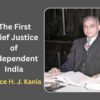
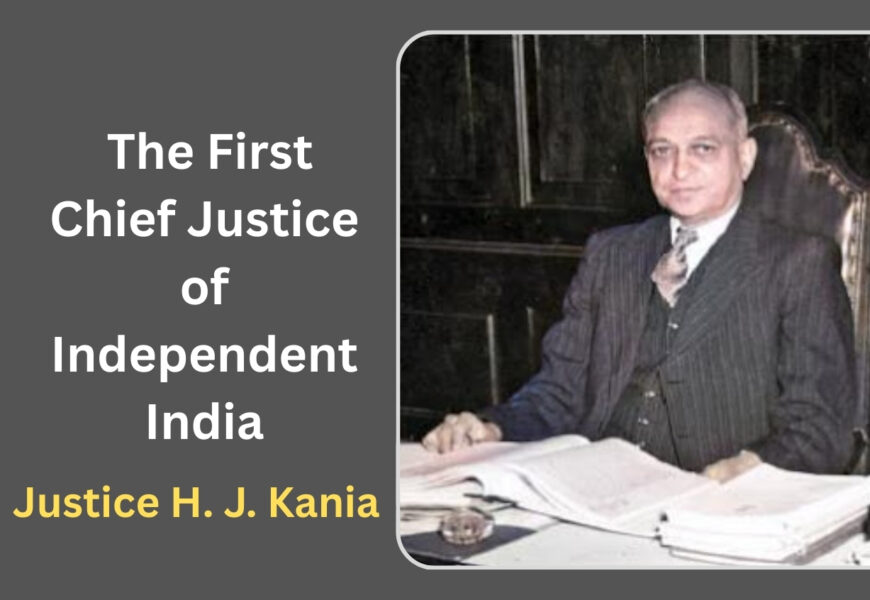
When a nation is born, it needs leaders who can set the tone for its future. In India, as the Constitution came into force in January 1950, all eyes turned towards the newly formed Supreme Court. Who would guide this institution, who would ensure that justice in free India was impartial and fearless? The answer came in the form of Justice Harilal Jekisundas Kania, the very first Chief Justice of India.
🌱 Humble Beginnings
Born in 1890 in Surat, Gujarat, Justice Kania grew up in a modest household. Like many young Indians of his time, he was deeply influenced by the values of hard work and honesty. Education was his ladder to success.
He studied law at the Government Law College, Bombay, where he earned not just degrees but also a reputation for his discipline and seriousness. Unlike some of his peers who were drawn to politics during the freedom struggle, Kania chose the quieter path of law and justice. His belief was clear: “Nations are built as much in courtrooms as in battlefields.”
⚖️ Rise Through the Legal Profession
Kania began his legal career at the Bombay High Court, where he practiced under eminent lawyers of his time. His sharp intellect and ability to simplify complex arguments quickly caught the attention of the bench and bar alike.
In 1933, he was appointed as a judge of the Bombay High Court. Over the years, he developed a reputation for impartiality, deep knowledge of law, and strict discipline in the courtroom. His colleagues often said that Kania’s court was not a place for drama but for reasoned argument.
By 1943, he had risen to become the Chief Justice of the Bombay High Court. And when the Federal Court of India was set up, Kania was elevated to serve as a judge there. This was the immediate predecessor to the Supreme Court of India.
🌟 January 26, 1950 – A New Dawn
On the historic morning of January 26, 1950, India’s Constitution came into effect, and with it, the Supreme Court of India was born. Harilal Jekisundas Kania was sworn in as the first Chief Justice of India.
It was a solemn but powerful moment. As he sat on the highest judicial chair in the land, Kania understood the weight of responsibility on his shoulders. He was not just heading a new court; he was setting traditions, procedures, and values for generations to come.
The very first sitting of the Supreme Court under his leadership signaled that the judiciary of independent India would be firm, impartial, and committed to the Constitution.
📜 Defining the Role of Judiciary
Kania’s tenure was short but significant. He believed that the judiciary’s primary role was to act as the guardian of the Constitution. His judgments emphasized that while the Parliament was supreme in lawmaking, the Constitution was the supreme law of the land.
He guided the court through its formative years, laying down rules of procedure, judicial decorum, and the relationship between the judiciary and other organs of the State.
One of his landmark observations was that fundamental rights are not to be treated lightly. They were not mere words on paper, but solemn promises to the citizens of India.
🙏 A Man of Discipline and Integrity
Justice Kania was not known for flowery speeches or dramatic remarks. He was a man of few words but immense discipline. His colleagues respected him for his fairness, humility, and clarity of thought.
Even outside the courtroom, he led a simple life. He avoided publicity and preferred his work to speak for him. This simplicity was perhaps his greatest strength — it showed that true leadership doesn’t need noise, only substance.
🌍 Legacy That Lives On
Sadly, Justice Kania’s tenure was cut short. He passed away in November 1951, less than two years after becoming Chief Justice. But in that short period, he gave India something priceless: a judiciary rooted in independence and dignity.
Every Chief Justice who followed built upon the foundation he laid. The authority, respect, and moral strength that the Supreme Court commands today can be traced back to the traditions set by Justice Kania.
💡 Lessons for Today’s Generation
From Justice Kania’s life, we can draw many lessons:
- Discipline builds credibility. In any profession, consistency and discipline speak louder than words.
- Simplicity is power. You don’t need to be loud to be effective; integrity is enough.
- Foundations matter. The values you establish today can guide generations tomorrow.
✨ Closing Thought
Justice H. J. Kania may not be remembered for fiery judgments or controversies. Instead, he is remembered for something far more important: being the steady hand that guided the Supreme Court in its infancy.
He proved that leadership is not about being the loudest voice in the room; it is about setting examples that last long after you are gone.
Whenever we speak of an independent judiciary in India, we must remember the quiet man from Surat who became its very first guardian — Justice Harilal Jekisundas Kania.