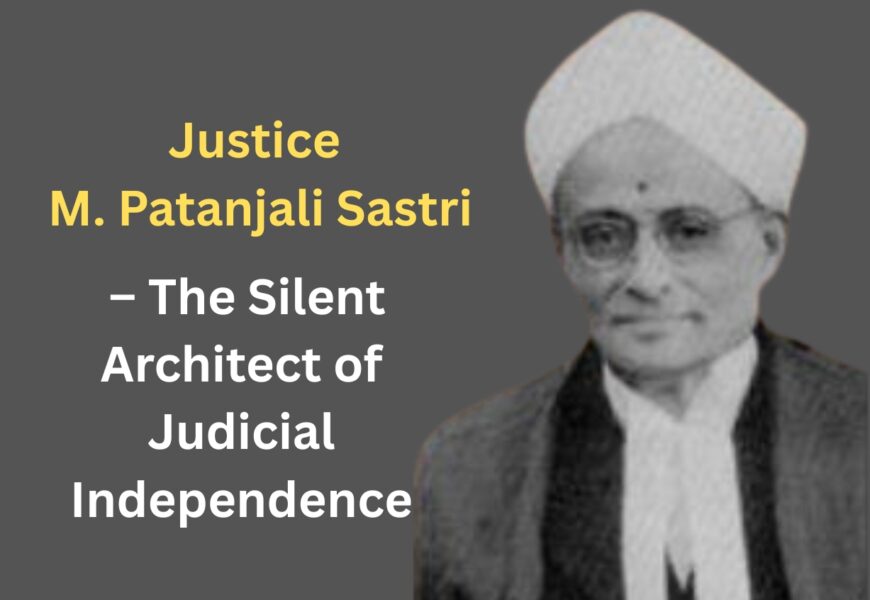
History often remembers the loud voices, the fiery speeches, and the dramatic judgments. But sometimes, the real architects of a nation’s destiny work quietly, leaving behind decisions and values that continue to shape society for decades. Justice Mandakolathur Patanjali Sastri, India’s second Chief Justice, was one such figure.
He wasn’t a man who sought the limelight. He wasn’t known for grand oratory or political presence. Instead, he let his judgments speak for him — judgments that gave life and strength to the Indian Constitution at a time when the Republic itself was still learning to walk.
🌱 Early Life and Education
Born in 1889 in Tamil Nadu, Sastri grew up in a traditional South Indian household where discipline and education were valued above all else. His childhood was modest, but even then, he displayed a sharp mind and a deep sense of fairness.
Choosing law as a career was not an accident for him. He was deeply fascinated by questions of justice, rights, and fairness. His years as a law student were marked not just by academic brilliance but also by a quiet determination — a belief that law is not just a profession, but a way to serve society.
⚖️ From Bar to Bench
Justice Sastri began his career at the Madras High Court bar, where he quickly established himself as an expert in taxation law and constitutional interpretation. At a time when India was still under colonial rule, Sastri’s clarity of thought and precision in argument earned him immense respect.
In 1947, when India achieved independence, the Federal Court of India (which later became the Supreme Court) needed judges who could shoulder the responsibility of interpreting a brand-new Constitution. Sastri was one of the natural choices. His appointment marked the beginning of his role as a guardian of India’s democracy.
By 1951, he rose to the position of Chief Justice of India, becoming the second person to occupy that chair. While he held the office for just two years, the impact of his tenure is still felt today.
🌟 The Landmark Judgment
Every judge is remembered for at least one defining case. For Justice Sastri, it was State of Madras vs. V. G. Row (1952).
The question before the Court was simple yet profound: How far can the State restrict fundamental rights in the name of public order?
Justice Sastri’s words in this judgment continue to resonate even today. He declared:
“Freedom of speech and expression is the very foundation of democracy. Without free political discussion, no public education, so essential for the proper functioning of the processes of popular government, is possible.”
At a time when the Constitution was barely two years old, Sastri set the tone: fundamental rights were not ornamental promises; they were living guarantees that gave citizens the courage to question the government.
This case is still cited in Indian courts whenever freedom of expression is at stake. That is the power of a judgment rooted in principle, not politics.
🙏 A Life of Simplicity
Despite being the Chief Justice of India, Sastri lived a remarkably simple life. He avoided unnecessary publicity and preferred his work to do the talking. His colleagues often described him as a man of few words but immense wisdom.
What made him truly special was his unwavering belief in judicial independence. For him, the judiciary was not a servant of the State, nor was it a tool of the people in power. It was the conscience of the Constitution — a role that had to be played without fear or favor.
🌍 Legacy
Justice Sastri passed away in 1963, but his legacy is everywhere around us. Every time the Supreme Court upholds freedom of expression, every time a judge reminds the government of its constitutional limits, there is an invisible thread connecting back to Sastri’s vision.
He may not be as widely celebrated as some other judges, but the truth is this: without people like him, the foundation of our judiciary would have been weak. His contribution is like the roots of a great tree — unseen, silent, but absolutely essential.
💡 What We Learn From Him
For today’s generation, Sastri’s life offers a powerful lesson. You don’t always need noise, slogans, or self-promotion to make a difference. Sometimes, integrity, consistency, and quiet courage can shape the destiny of an entire nation.
As young professionals, students, or lawyers, we can learn from Sastri’s example:
- Do your work with sincerity. You may not always be in the spotlight, but your efforts will matter.
- Stand by principles. Even if the world isn’t watching, the truth has a way of surviving.
- Value freedom. Without liberty, democracy is nothing more than a hollow shell.
✨ Closing Thought
Justice M. Patanjali Sastri was not just a judge; he was a builder of trust between citizens and the Constitution. His judgments are not just pages in law books; they are guiding lights for every democracy-loving individual.
Whenever we speak freely, write openly, or criticize power without fear, we unknowingly carry forward his legacy.
Sometimes the greatest heroes are the quietest ones — and Justice Sastri was one such hero.