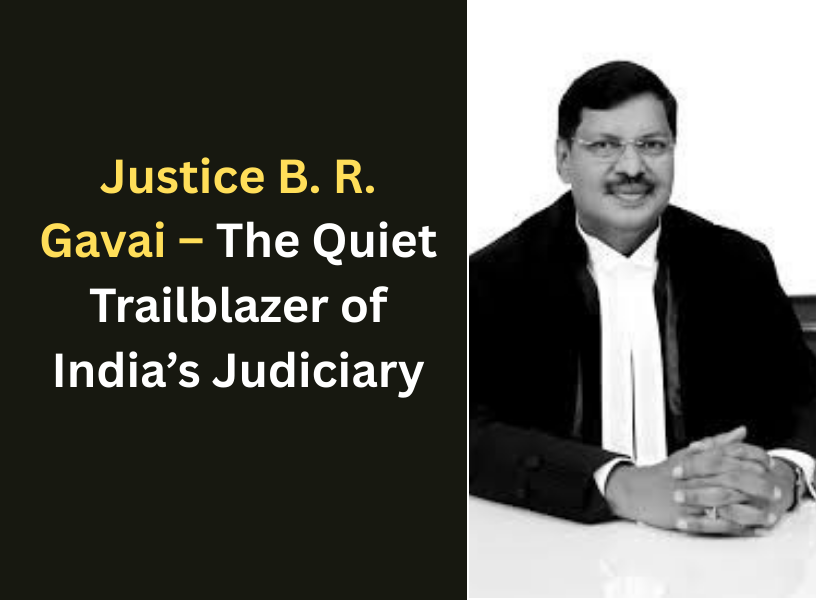
Every once in a while, someone steps into a leadership role not with fanfare, but with a sense of purpose that quietly inspires trust. Justice Bhushan Ramkrishna Gavai, India’s 52nd Chief Justice, embodies that understated strength. As the first Buddhist and only the second Dalit to hold this position, his journey and philosophy offer both intrigue and inspiration.
A Legacy Rooted in Justice and Equality
Born in 1960 in Amravati, Maharashtra, Gavai hails from a family deeply inspired by Dr. B. R. Ambedkar’s ideals of social justice. His father, R. S. Gavai—a noted politician and social activist—embraced Buddhism alongside Ambedkar, instilling in his son the belief that law could and should elevate the marginalized. Justice Gavai’s own calling to law was much more than a profession—it was a continuation of a legacy rooted in equality and purpose.
From Nagpur Courtrooms to Supreme Bench
Justice Gavai began practicing law in 1985, gradually making his mark in Constitutional and Administrative Law, especially before the Nagpur Bench of the Bombay High Court, Supreme Court Observer. Over time, he held key positions like Standing Counsel and Public Prosecutor in various municipal and governmental bodies. In 2003, his judicial journey began in earnest with his elevation as a High Court judge, followed by his appointment to the Supreme Court in 2019 Wikipedia.
Sworn In as CJI — A Historic Day
On 14 May 2025, in a quiet yet historic ceremony at Rashtrapati Bhavan, Justice Gavai took the oath as the Chief Justice of India, administered by President Droupadi Murmu. In doing so, he became the first Buddhist and only the second Dalit to hold this revered position—the first being Justice K. G. Balakrishnan.
A Philosopher on the Bench
Justice Gavai’s rulings reflect his unwavering commitment to constitutional values. He played key roles in landmark cases—such as upholding the abrogation of Article 370, striking down the Electoral Bonds Scheme, and curbing bulldozer demolitions without due process.
Yet, even amid high-profile judgments, he brings humility and restraint. During the Emergency plea in West Bengal, he cautioned the Court against overreach, emphasizing the need for institutional balance Supreme Court Observer. And in a powerful address at NALSAR, he warned that India’s legal system is “badly in need of fixing,” urging reforms to tackle delays, inefficiencies, and barriers to justice.
Dignity, Leadership, and Inclusivity
Justice Gavai often reminds us what truly anchors our Constitution. In a recent address, he declared: “Human dignity is the soul of our Constitution”, emphasizing that respect for every individual—whether prisoners, women, or persons with disabilities—is central to constitutional interpretation The Times of India.
Moreover, he sees symbols of representation as milestones on the broader path to justice. While acknowledging the importance of President Droupadi Murmu’s appointment—India’s first tribal woman President—he remains keenly aware that inclusion must translate into tangible equality The Times of India.
What His Story Teaches Us
From Justice Gavai, we learn that:
- Leadership isn’t always loud—it’s consistent, grounded, and principled.
- Justice means serving the least served, echoing his father’s and Ambedkar’s legacy.
- Institutional reform is urgent—he focuses on improving how justice works, not just what it delivers.
- Equality starts at the top, but needs to resonate across society.
Closing Thought
Justice B. R. Gavai stands tall—not as a figure of pomp, but as a quiet trailblazer, chiseling a more just and inclusive Indian judiciary. His life bridges tradition and progress, power and purpose. His tenure signals that justice isn’t just about verdicts—it’s about dignity, equity, and the faith of millions.
Whenever we talk about hope in law and fairness in society, names like Gavai quietly lead the conversation.